Showing posts with label History. Show all posts
Showing posts with label History. Show all posts
Thursday, November 11, 2010

History and Background
It was 1 March 1954, Monday morning on 6:45 when task force commander Clarkson affirmed his command to fire a hydrogen bomb, codenamed “Bravo” over the Nam Island on Bikini Atoll. The bomb was equivalent to 17 Megatons which was 1300 times much more than the cataclysmic power of the bomb dropped on Hiroshima. After the World War II, atomic bomb had been developed rapidly, especially in America and The Soviet Union. From 1946 to 1958, America had conducted various nuclear testing programs, in the US Proving Ground, including 67 nuclear tests at Bikini and Enewetak atolls.
Operation Castle
Operation Castle was one of the nuclear testing programs which were carried out in Bikini Atoll. America chose Bikini Atoll for nuclear testing program because they need bigger space than Eniwetok to run the test and also the consideration that it is located far away from populated area on Earth. Operation castle consisted of 6 detonations of atmospheric nuclear test, which is a detonation that takes place above the ground surface. The purpose of this operation was to test a series of high yield thermonuclear weapon design which can be delivered by aircraft.
The six experiments are: 1. Bravo
2. Romeo
3. Koon
4. Union
5. Yankee
6. Nectar
AEC Authorization for Operation Castle

Castle Bravo
Castle Bravo Nuclear Test
The most famous of the series of the test was Operation castle Bravo. It was the biggest nuclear explosion ever conducted by the US. It gained notoriety because it caused 2.5 times more yield than predicted. This came from a theoretical error when designing the bomb. As a result, the fallout reached some populated islands, and a nearby Japanese fishing vessel (Daigo Fukuryu Maru) was affected by the fallout.

Bravo Test Fallout Pattern


Effects on the people living in Rongelap, Ailinginae,and Utrik
No Bikinians were living in the bikini atolls at the time Bravo explode, because US authorities already evacuate them. Even so, because of the failures in forecasting and analysing weather patterns, and Bravo miscalculation, 236 people in living in Rongelap, Ailinginae,and Utrik were heavily contaminated to the radiation. The water became blackish yellow and the island was covered by a two inch layer of ashes. They soon indicate the symptoms of high radiation exposure, such as hair loss, decreased white blood cell counts, and skin burns. Later, they were all evacuated to Kwajalein for medical treatment.
Short History of Bikini Atoll People
Bikini Atoll is one of the 29 atolls and five islands that compose the Marshall Islands. These atolls of the Marshalls are scattered over 357,000 square miles of a lonely part of the world located north of the equator in the Pacific Ocean. They help define a geographic area referred to as Micronesia. Once the Marshalls were discovered by the outside world, first by the Spanish in the 1600's and then later by the Germans, they were used primarily as a source for producing copra oil from coconuts. The Bikini islanders maintained no substantial contacts with these early visitors because of Bikini Atoll's remote location in the very dry, northern Marshalls. The fertile atolls in the southern Marshalls were attractive to the traders because they could produce a much larger quantity of copra. This isolation created for the Bikinians a tightly integrated society bound together by close extended family association and tradition, where the amount of land you owned was a measure of your wealth.
In the early 1900's the Japanese began to administer the Marshall Islands. This domination later resulted in a military build up throughout the islands in anticipation of World War II. Bikini and the rest of these peaceful,  low lying coral atolls in the Marshalls suddenly became strategic. The Bikini islanders' life of harmony drew to an abrupt close when the Japanese decided to build and maintain a watchtower on their island to guard against an American invasion of the Marshalls. Throughout the conflict the Bikini station served as an outpost for the Japanese military headquarters in the Marshall Islands, Kwajalein Atoll.
After the war, in December of 1945, President Harry S. Truman issued a directive to Army and Navy officials that joint testing of nuclear weapons would be necessary "to determine the effect of atomic bombs on American warships." Bikini, because of its location away from regular air and sea routes, was chosen to be the new nuclear proving ground for the United States government.
In February of 1946 Commodore Ben H. Wyatt, the military governor of the Marshalls, traveled to Bikini. On a Sunday after church, he assembled the Bikinians to ask if they would be willing to leave their atoll temporarily so that the United States could begin testing atomic bombs for "the good of mankind and to end all world wars." King Juda, then the leader of the Bikinian people, stood up after much confused and sorrowful deliberation among his people, and announced, "We will go believing that everything is in the hands of God."
 While the 167 Bikinians were getting ready for their exodus, preparations for the U.S. nuclear testing program advanced rapidly. Some 242 naval ships, 156 aircraft, 25,000 radiation recording devices and the Navy's 5,400 experimental rats, goats and pigs soon began to arrive for the tests. Over 42,000 U.S. military and civilian personnel were involved in the testing program at Bikini.
The nuclear legacy of the Bikinians began in March of 1946 when they were first removed from their islands in preparation for Operation Crossroads. The history of the Bikinian people from that day has been a story of their struggle to understand scientific concepts as they relate to their islands, as well as the day-to-day problems of finding food, raising families and maintaining their culture amidst the progression of events set in motion by the Cold War that have been for the most part out of their control.
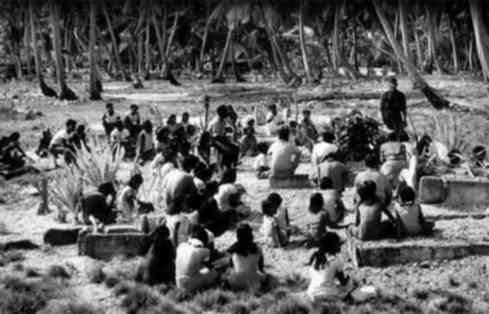 In preparation for Operation Crossroads, the Bikinians were sent 125 miles eastward across the ocean on a U.S. Navy LST landing craft to Rongerik Atoll. The islands of Rongerik Atoll were uninhabited because, traditionally, the Marshallese people considered them to be unlivable due to their size (Rongerik is 1/6 the size of Bikini Atoll) and because they had an inadequate water and food supply. There was also a deep-rooted traditional belief that the atoll was inhabited by evil spirits. The Administration left the Bikinians food stores sufficient only for several weeks. The islanders soon discovered that the coconut trees and other local food crops produced very few fruits when compared to the yield of the trees on Bikini. As the food supply on Rongerik quickly ran out, the Bikinians began to suffer from starvation and fish poisoning due to the lack of edible fish in the lagoon. Within two months after their arrival they began to beg U.S. officials to move them back to Bikini.

The two atomic bomb blasts of Operation Crossroads were both about the size of the nuclear bomb dropped on Nagasaki, Japan. Eighteen tons of cinematography equipment and more than half of the world's supply of motion picture film were on hand to record the Able and Baker detonations, and also the movement of the Bikinians from their atoll.
From December of 1946 through January of 1947, the food shortages worsened on Rongerik; the small population of Bikinians was confronted with near starvation. During the same period of time, the area of Micronesia was designated as a United Nations Strategic Trust Territory (TT) to be administered by the United States. Indeed, it was the only strategic trust ever created by the United Nations. In this agreement, the U.S. committed itself to the United Nations directive to "promote the economic advancement and self-sufficiency of the inhabitants, and to this end shall...protect the inhabitants against the loss of their lands and resources
..." The people of Bikini have long seen the irony in the conduct of the TT agreement that allowed the bombing of their homeland and that forced them into starvation on Rongerik Atoll.
For more details please click HERE
Daigo Fukuryu Maru (The Lucky Dragon No.5)
People in the Marshall Island were not the only victims of the tremendous blast. One and a half hour after the explosion, a 140-ton tuna fishing boat from Yaizu, Shizuoka Prefecture which was sailing 100 miles east of Bikini were also heavily contaminated by the radiation. Despite being a secret, the test gained international attention because the fallout from the explosion poisoned the Daigo Fukuryu Maru crews. This created an international concern regarding atmospheric thermonuclear test and severed the diplomatic relationship with Japan.
Since the fishermen were operating outside of the danger zone given by the US authorities, they were unaware of the danger of the atomic explosion they saw. After seeing a bright flash light in the sky that lit up like a sunrise, eight minutes later they heard the sound of the explosion and continued by the rained of cloud of white radioactive ash for approximately 3 hours. This ashes which was later known as “ashes of the death” contaminated not only the 23 crew members, but also the fishes that they had caught.
Soon after being exposed to this fallout, the crew members start to suffer from itching skin, nausea, and vomiting. On their way back home, their skin began to darken, hair loosened and started to fallout, pain in the eyes, and bleeding from the gums. On Sunday, 14 March 1954, they arrived in their home port, Yaizu, Shizuoka. The next day, 2 of them were sent to Tokyo University Hospital for an examination. And on 16 March, they were officially announced to be exposed by the fallout. The remaining 21 crew members were then hospitalized in Tokyo for about a year. The ship was quarantined and later in 1967 it was abandoned at Yumenoshima, a graveyard for wooden ships in Tokyo Bay. Now, the ship is in the Tokyo Metropolitan Daigo Fukuryu Maru Exhibition Hall as a monument.
Fukuryu Maru brought back 12.000 pounds of sharks and tuna which was sent right away to the fish market in Japan. A young professor called Yashushi Nishiwaki discovered that the fishes were also heavily contaminated. Contaminated fish were then deeply buried, but some had been sold. This automatically feared the entire Japan. People stopped consuming fish and as the result, price of fish fall down and bankruptcy of fish-dealers. By the end of 1954, 856 Japanese fishing boats were confirmed exposed by the radiation.
On 23 September 1954, Aikichi Kuboyama, the chief of radio operator passed away after fell into a coma and suffering from low white blood cell counts. He was the first Japanese victim of a Hydrogen bomb although America has never declared that he died because of “Bravo”. His last words before he died were "I pray that I am the last victim of an atomic or hydrogen bomb." This incident also triggered Japanese film makers to create “Gojira”, monsters that are mutated because of the impact of radiation.
The Route
This picture showed the route that was taken by Daigo Fukuryu Maru.
They changed the route and went to east of Japan.

On the middle, they found out that the net was broken and at last they decided to change the route and headed south while trying to save the fuel and went back to Japan. Unfortunately, they apparently were crossing the area where the hydrogen bomb was tested in Bikini Atoll.

Subscribe to:
Posts (Atom)